

Water conservation has become a priority for homeowners across the globe. Greywater recycling offers an excellent solution for reducing water waste and utility bills. At South East on Rent, we understand that choosing between a gravity-fed and pumped greywater system depends largely on cost, property layout, and personal preferences. This guide breaks down the expenses associated with each system type to help you make an informed decision.
Understanding Greywater Systems
Greywater refers to gently used water from sinks, showers, washing machines, and bathtubs. Unlike blackwater from toilets, greywater can be recycled for irrigation and toilet flushing. Both gravity-fed and pumped systems collect this water, but they differ significantly in their operation and installation requirements.
Gravity-fed systems rely on natural water flow from higher to lower elevations. Therefore, they work best when your greywater sources sit above the irrigation area. Pumped systems, however, use mechanical pumps to move water uphill or across long distances. Understanding how much do greywater reuse systems cost to install helps you budget appropriately for your project.
Gravity-Fed Greywater System Costs
Gravity-fed systems typically cost between $500 and $2,500 for basic installations. These systems are the most affordable option because they require minimal mechanical components. The simplicity of design translates to lower upfront expenses and reduced maintenance costs over time.
Installation costs vary based on several factors. First, the distance between your water source and irrigation area affects piping expenses. Second, the complexity of your landscape influences excavation needs. Third, local permit requirements may add fees ranging from $50 to $300.
Materials for gravity-fed systems include PVC pipes, diverter valves, and surge tanks. A basic diverter valve costs around $100 to $300. Additionally, you might need a mulch basin or simple filtration system, which adds another $200 to $500. Professional installation typically runs $500 to $1,500, depending on your location and project scope.
Pumped Greywater System Costs
Pumped systems represent a more significant investment, typically ranging from $2,000 to $10,000 or more. The higher cost stems from the need for pumps, controllers, and more complex plumbing networks. However, these systems offer greater flexibility for properties where gravity flow is not possible.
The pump itself constitutes a major expense. A quality greywater pump costs between $400 and $1,200. Controllers and automation systems add another $300 to $800. Moreover, electrical work for powering the pump can increase costs by $500 to $1,500, especially if new circuits are required.
Installation complexity drives up labor costs for pumped systems. Professional installers charge $1,500 to $5,000 for complete setup. This includes electrical connections, pump installation, filtration systems, and pressure tanks. Furthermore, some municipalities require licensed plumbers or electricians, which increases hourly rates.
Comparing Long-Term Operating Costs
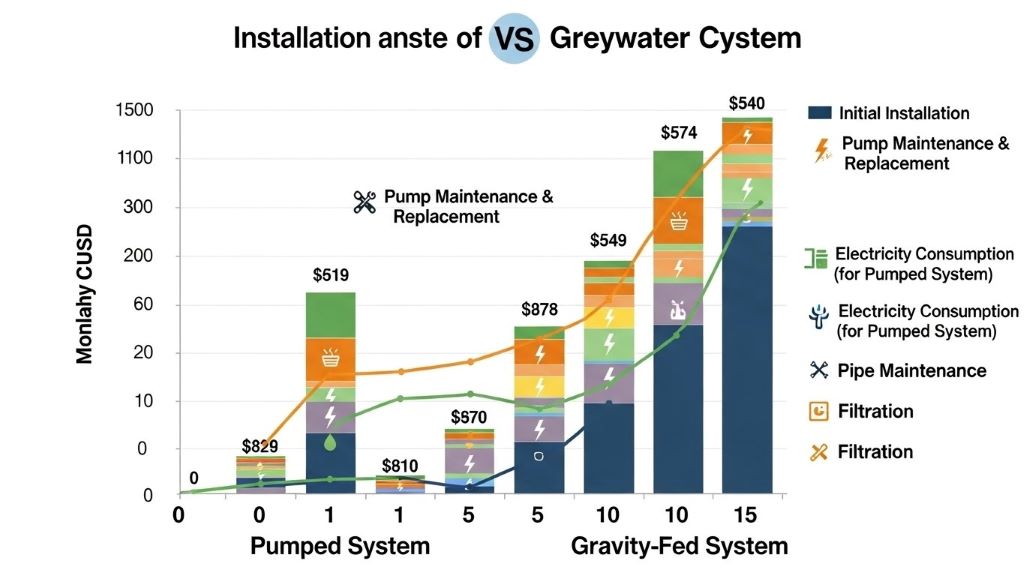
Beyond initial installation, operating costs differ substantially between the two systems. Gravity-fed systems have minimal ongoing expenses. They require no electricity and have few mechanical parts that might fail. Annual maintenance typically costs less than $100 for basic inspections and filter cleaning.
Pumped systems incur regular electricity costs. A typical greywater pump uses 50 to 150 watts and runs intermittently throughout the day. This translates to approximately $50 to $150 annually in electricity bills. Additionally, pumps eventually wear out and require replacement every 7 to 15 years, costing $400 to $1,200 per replacement.
Maintenance for pumped systems is more involved. Filters need cleaning or replacement every few months, costing $50 to $200 annually. Pumps require periodic inspections by professionals, adding another $100 to $300 yearly. Therefore, over a 15-year period, pumped systems can cost $3,000 to $6,000 more in operating expenses.
Factors Influencing Your Choice
Your property’s topography plays the most critical role in system selection. If your bathroom and laundry areas sit uphill from your garden, gravity-fed systems work perfectly. Conversely, properties with challenging layouts benefit from pumped systems despite higher costs.
Climate considerations also matter. In regions with freezing winters, pumped systems can be installed in heated spaces to prevent damage. Gravity-fed systems with outdoor components may require winterization or seasonal shutdown. According to the Environmental Protection Agency, proper system design ensures year-round functionality in most climates.
Local regulations significantly impact costs and feasibility. Some jurisdictions have strict greywater codes requiring professional installation and specific components. Research your local building department’s requirements before proceeding. Additionally, some areas offer rebates for greywater system installation, potentially offsetting 10% to 30% of total costs.
Cost-Benefit Analysis
Calculating return on investment helps justify the expense. The average household generates 50 to 100 gallons of greywater daily. Recycling this water saves approximately $200 to $500 annually on utility bills, depending on local water rates. Therefore, a gravity-fed system can pay for itself within 2 to 5 years, while pumped systems take 5 to 15 years.
Environmental benefits extend beyond financial savings. Greywater recycling reduces strain on municipal water supplies and wastewater treatment facilities. Each household using greywater systems prevents thousands of gallons from entering sewage systems annually. This conservation effort becomes increasingly valuable during droughts and water restrictions.
Property value considerations also come into play. Homes with sustainable features often command premium prices in real estate markets. A well-designed greywater system demonstrates environmental stewardship and can attract eco-conscious buyers. However, the value addition varies by region and buyer preferences.
Making Your Decision
Start by assessing your property’s layout and elevation changes. Measure the vertical distance between greywater sources and irrigation areas. If you have at least 18 inches of downward slope, gravity-fed systems become viable. Otherwise, pumped systems provide the necessary flexibility.
Consider your budget for both installation and long-term operation. Gravity-fed systems suit homeowners seeking minimal upfront costs and simple maintenance. Pumped systems work better for those prioritizing functionality over initial savings. Additionally, factor in your comfort level with DIY projects versus professional installation.
Consult with local greywater specialists for site-specific recommendations. Many companies offer free assessments and provide detailed quotes. These professionals can identify potential challenges and suggest solutions that DIY guides might overlook. Furthermore, they ensure compliance with local codes, preventing costly modifications later.
Conclusion
Choosing between gravity-fed and pumped greywater systems ultimately depends on your property characteristics, budget, and conservation goals. Gravity-fed systems offer affordability and simplicity, costing $500 to $2,500 with minimal operating expenses. Pumped systems provide flexibility for challenging sites but require $2,000 to $10,000 upfront plus ongoing electricity and maintenance costs.
Both options deliver substantial water savings and environmental benefits. Gravity-fed systems typically achieve faster payback periods, while pumped systems enable greywater recycling where it would otherwise be impossible. Evaluate your specific situation carefully, research local regulations, and consider consulting professionals to ensure successful implementation.
By investing in greywater recycling, you contribute to water conservation efforts while reducing household expenses. Whether you choose gravity-fed or pumped systems, the long-term benefits for your wallet and the environment make this sustainable choice worthwhile.
Frequently Asked Questions
-
Can I install a greywater system myself to save money?
Yes, many homeowners successfully install gravity-fed systems as DIY projects, potentially saving $500 to $1,500 in labor costs. However, pumped systems typically require professional installation due to electrical work and complex plumbing. Always check local regulations, as some jurisdictions mandate licensed installer involvement regardless of system type.
-
How much water can I expect to save with a greywater system?
The average household generates 50 to 100 gallons of greywater daily from showers, sinks, and washing machines. This translates to annual savings of 18,000 to 36,000 gallons, reducing water bills by $200 to $500 depending on local utility rates. Actual savings vary based on household size and water usage patterns.
-
Do greywater systems require special permits?
Most jurisdictions require permits for greywater system installation, though requirements vary significantly. Permit fees typically range from $50 to $300. Some areas have streamlined processes for simple systems, while others mandate detailed plans and inspections. Contact your local building department early in the planning process to understand specific requirements.
-
What maintenance do greywater systems need?
Gravity-fed systems require minimal maintenance, including periodic filter cleaning, visual inspections, and occasional valve adjustments. This typically costs under $100 annually. Pumped systems need more attention, including filter replacement, pump inspections, and electrical component checks, totaling $150 to $500 yearly. Both systems benefit from professional inspections every few years.
-
Are there rebates or incentives for installing greywater systems?
Many municipalities and water districts offer rebates ranging from $200 to $1,500 for greywater system installation. Some states provide tax credits or expedited permitting for sustainable water projects. Additionally, utility companies in drought-prone areas often have conservation programs with financial incentives. Check with your local water authority and state environmental agency for available programs.
Related Topics: